Showing posts with label 1951. Show all posts
Showing posts with label 1951. Show all posts


Style Statements - Animal Print and Vintage Muffs
Wednesday, November 16, 2011 0 comments |
| 1951 |
Muffs like this one were popular from the 30s to the 50s. They are a great way to keep your hands warm when the winter wind blows. Most have hidden zipper pockets so you can carry your I.D., some money and your lipstick. I'll bet you could even fit your cellphone in there. And who needs more than that when you want to make a style statement? We've got a couple of muffs available at Couture Allure right now. Check them out!

What We Were Wearing - Fall 1951
Monday, November 14, 2011 0 commentsHere is what women were wearing 60 years ago this month.
 After being introduced 3 years previous by Dior, full skirted dresses and skirts are now becoming popular and worn for everyday wear by most women. The skirts are more bell-shaped than the full circles that will become stylish in a few years. Most are worn without crinolines for daytime.
 Every woman had a basic suit in her closet to wear in town, for meetings with professionals, for shopping in the city, or for dinner at a fancy restaurant.
 For more casual daytime wear, a skirt with a blouse, sweater or twin set was the way to go. Pants were rarely worn by women, and if they were it was strictly for work around the house or farm.
 Princess line and swing coats were the newest styles that came about to accommodate the fuller skirts, but many women also wore simple straight coats.
 Most women had or wanted a fur jacket or stole in their closets. For those who could not afford expensive options like mink or fox, there were many made from less costly furs like marmot, mouton and rabbit.
 Full skirted styles were popular for evening and cocktail wear.
 Evening gowns were elaborate with draped skirts and trains with rich satins being most popular.
 No matter who you were, you rarely left the house bare headed. Hats were a fashion necessity.


Weekend Eye Candy - Jean Desses, 1951
Saturday, September 10, 2011 0 comments
New Ways to Wear a Scarf - 1951
Tuesday, May 17, 2011 0 comments
One of the most versatile and dramatic accessories in your wardrobe is a pretty scarf. Scarves add a pop of color to any outfit. Fill your closet with high quality basics and dress them up in a myriad of ways with a collection of scarves. Here are some different and fun ways to wear a scarf from 1951. Need more? Blogger Une Femme has put together some fabulous videos showing various techniques for tying scarves. I find myself referring to these over and over.
 Loop an 18" square over your belt and hold it in place with a vintage brooch.
 Twist that same small square scarf through a string of pearls and knot at the side.
 For a 36" square scarf, pull it through your belt and tuck a corner into the neckline of your dress. Let the rest of the square hang loose in an apron effect. This works best with a fabric that has stiffness or body, like taffeta.
 For a blouse effect under a suit jacket, take a 36" square scarf, fold it in half diagonally and wrap around your neck with the point to the back of your neck. Tuck the ends into your belt or skirt waistband.
 Take a dress with simple lines and jazz it up with a long rectangular stole draped over your neck and belted. This works best with a light and floaty scarf.
 Use a large rectangular scarf in a bold pattern as a stole with a simple cocktail dress.
 Or tie that same stole around your waist looping the ends over each other for a dramatic accent to your skirt.
Did you know that we offer a wonderful selection of vintage and designer scarves at Couture Allure? Check them out!


Did you know that we offer a wonderful selection of vintage and designer scarves at Couture Allure? Check them out!
What's in a Size? 1950s Petites and Half Sizes
Thursday, May 12, 2011 0 comments
Sizing standards have changed so much over the years, it's hard to know what size one wears any more. Add to that the fact that in the 1950s, garment manufacturers made clothes in many more sizes than their counterparts today, and the choices can be dizzying. This week we're looking at the various size ranges manufactured in the 1950s and what that means for you when you're shopping for a vintage dress.
Petite or Diminutive sizes are made for a woman is 5 feet 5 or under. This woman will find that a misses size fits at the shoulders, waistline and hips, but is much too long-waisted and long in length. Petite sizes are even numbers, usually 10 - 18 and will be shorter in overall length and from shoulder to waist (usually 14" - 15"). Here are two examples from 1951.
 This Martha Manning Petites suit of beige sharkskin is sized proportionately for the shorter woman and looks great with the poodle cloth stole.
 This woman is in her 40s, but her figure is sleek enough for this dress and jacket set by Hannah Troy in petite sizing.
Half sizes are for women who are high waisted (usually 15" - 16" shoulder to waist) but a bit wider and heavier than the petite woman. Half sizes run from 10 1/2 to 24 1/2. Here are two examples from 1951.
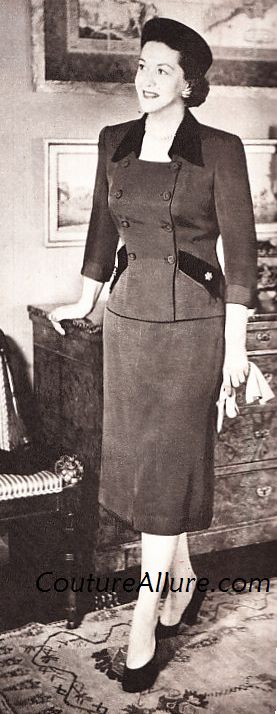
 For the woman who is a bit heavier and shorter but still trim, this half size suit by Forever Young in rayon ottoman with velvet trim is a wonderful option.
 For the fuller but shapely and shorter figure, a half size is the perfect choice. This black dress by Young Viewpoint has an easy skirt and points at the neckline to give a look of length.
Petite or Diminutive sizes are made for a woman is 5 feet 5 or under. This woman will find that a misses size fits at the shoulders, waistline and hips, but is much too long-waisted and long in length. Petite sizes are even numbers, usually 10 - 18 and will be shorter in overall length and from shoulder to waist (usually 14" - 15"). Here are two examples from 1951.


Half sizes are for women who are high waisted (usually 15" - 16" shoulder to waist) but a bit wider and heavier than the petite woman. Half sizes run from 10 1/2 to 24 1/2. Here are two examples from 1951.

What's in a Size? 1950s Misses Sizes
Wednesday, May 11, 2011 0 comments
Sizing standards have changed so much over the years, it's hard to know what size one wears any more. Add to that the fact that in the 1950s, garment manufacturers made clothes in many more sizes than their counterparts today, and the choices can be dizzying. This week we're looking at the various size ranges manufactured in the 1950s and what that means for you when you're shopping for a vintage dress.
If you're tall and slim, you probably wear a misses size. Misses sizes are perfect for the slender woman with wide shoulders, a long waist (at least 16" shoulder to waist) and long legs. The size numbers are even and in the 1950s started at 8 and ran up to a 20. The clothes shown here are all from 1951. All four women are different ages, but all wore a size 12.
 Every woman should have a black crepe dress in her wardrobe. This one by Herbert Sondheim has that touch of sophistication with it's soft skirt and flashes of yellow at the throat and cuffs.
 This young looking grandmother wears a gray wool suit by Anna Miller. The stiffened swirled peplum is a feature that she has the height to wear successfully.
 If you're a young woman who likes to experiment, try a coat and dress ensemble instead of a suit. This one by Pat Warren for Nantucket Naturals is in three tones of yarn dyed gray wool jersey.
 A teenager tall enough to wear a misses' size will find that most vintage dresses that fit look too mature. Try separates instead! A plaid cotton shirt and pleated gray flannel skirt by Toni Owen are simple and smart.
If you're tall and slim, you probably wear a misses size. Misses sizes are perfect for the slender woman with wide shoulders, a long waist (at least 16" shoulder to waist) and long legs. The size numbers are even and in the 1950s started at 8 and ran up to a 20. The clothes shown here are all from 1951. All four women are different ages, but all wore a size 12.


What's in a Size? 1950s Junior Sizes
Tuesday, May 10, 2011 0 comments
Sizing standards have changed so much over the years, it's hard to know what size one wears any more. Add to that the fact that in the 1950s, garment manufacturers made clothes in many more sizes than their counterparts today, and the choices can be dizzying. This week we're looking at the various size ranges manufactured in the 1950s and what that means for you when you're shopping for a vintage dress.
Today we'll analyze junior sizes. Please be assured, a junior size does not mean the dress was made for a teenager! Junior-miss garments were made for a woman who is high-busted, slender-waisted and a slight touch shorter from shoulder to waist (usually 15" - 15 1/2"). Many women have this figure at seventeen and work hard to keep it all their lives. Junior sizes are odd numbers, often starting as low as a 3 and running up to 17. All the clothing shown here is from 1951.
 When you're over forty and still a junior size, look for a dress like this. There's easy fullness in the skirt, pretty but not teenage details in the pockets. Ira Rentner dress in a two-tone amethyst wool check trimmed with amethyst colored pins.
 For the career woman who wears a junior size, this gray flannel dress by Carlye has long lapels that button over like a bolero to flatter a high and small waist. Slim lines make it an "all day long" and "all occasion" dress for all but the very young.
 This dress by Youth Guild is perfect for the young woman for whom junior sizes were originally designed. Scoop neck dress in lilac wool trimmed with braid.
 The sophisticated woman in her thirties with a junior figure will find this long sleeved dress with high round neckline has a slim elegance not usually associated with junior dresses. Dress by Anne Fogarty in dark gray flannel is accented with an ermine collar.
Today we'll analyze junior sizes. Please be assured, a junior size does not mean the dress was made for a teenager! Junior-miss garments were made for a woman who is high-busted, slender-waisted and a slight touch shorter from shoulder to waist (usually 15" - 15 1/2"). Many women have this figure at seventeen and work hard to keep it all their lives. Junior sizes are odd numbers, often starting as low as a 3 and running up to 17. All the clothing shown here is from 1951.


Consider Your Hairdo When Choosing a Vintage Hat
Thursday, May 5, 2011 0 comments
If you like to wear vintage hats like I do, you'll want to consider how the hat looks with your hairdo. As hat styles changed over the years, so did coiffures. In the 40s, when victory rolls were popular, tiny "doll" hats were worn tipped to the front or the side to accent the hairstyle. In general, hats work best with short hair or up dos. The photos below are all from 1951 and show how hair can be styled to complement a particular hat.
 Neat curls at the top and sleek sides in a hairdo by Dimitri. The black wool dress with asymmetric neckline is by Jacques Fath for Joseph Halpert.
 A small shallow pillbox hat by Mr. John is worn slightly tipped to the side and covers the curls at the top of the head. Note how the short hair allows the large mantle collar of Pauline Trigere's coat to frame the face.
 Here, longer hair is worn brushed back from the face and curled at ear level. The Hadley cashmere sweater is accented with a beaded choker necklace.
 A green bonnet by Chanda fits beautifully over the hairstyle and the face veil slips right over the curls. Gray flannel suit by Alan Graham.
 Medium length hair is swept to the side in a dramatic curl. Hairdo by Enrico Caruso. Silk dress by Claire McCardell.
 This dramatic hat by Braagaard is worn tilted to the side to show off the sideswept curls. See how that works? Black velvet dinner dress by Maurice Rentner.


Weekend Eye Candy - Lanvin-Castillo, 1951
Saturday, April 2, 2011 0 comments This gown is an incredible feat of architecture. Need I say more? Lanvin-Castillo, spring 1951.
Add Flowers to Your Look
Monday, August 16, 2010 0 comments Even though summer is on the wane, it's not too late to freshen up your tired wardrobe by adding some silk flowers to your look. You can find plenty of gorgeous flowers to use at your local fabric or craft stores. It's easy to pop the flower heads off the wire stems and apply them to your garment with hand stitches. And they're easy to remove again when you want to go back to the original look! Here are some ideas from 1951.
Above, Christian Dior uses pink rose to adorn his white silk tulle gown.
 Pierre Balmain fills the neckline of a gray suit with palest pink carnations.
 Maggy Rouff fills the bustline of her silk organza gown with a bouquet of miniature spring flowers.
 Cover your chignon with a bouquet of violets.
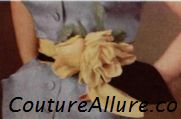 A large flower at your waist is very eye-catching and a great way to change your look!
Weekend Eye Candy - Marcel Rochas, 1951
Saturday, May 1, 2010 0 comments Marcel Rochas, 1951. Grey silk tulle is accented with yellow roses. Swoon.
The Look of Suits - 1951
Thursday, April 15, 2010 0 comments
In 1951, ladies suits were tailored to show off a tiny waist. Design details were used to great effect to fool the eye and make waistlines appear even smaller than they were. Hem lengths for straight skirts fell 3"-4" below the knee. While fuller skirts were finally starting to become popular, most women opted for the classic straight skirt when purchasing a suit. Enjoy these beauties from 1951!
 How can you not go crazy for this suit by Schiaparelli? 4 diagonal pleats all converge at the waist with a big button right in the center. It appears that the hipline of the jacket is flared just slightly with the use of stiff interlining. That technique also makes the waist appear tiny.
 Adele Simpson wool suit in black and white tweed with black velvet lining the neckline. The black buttons end right at the waist and your eye is drawn right to that point. The hips stand away just slightly to make the waist appear small. Suit sold for $155 in 1951 (about $1297 in today's dollar).
 Swansdown offered this wool tweed suit. The jacket has a subtle stripe that co-ordinates with the skirt. Those big pocket flaps accent the width of the hips, making the waist appear smaller. The suit sold for $80 in 1951 (about $670 in today's dollar).
 Famous furrier Revillon offered this suit in wool with an attached Karakul lamb fur stole. Here the jacket flares into a pleated peplum and the waist is belted, all to accent the appearance of slimness.
 Another Adele Simpson suit, this time in black and white micro-herringbone check with black velvet at the collar. Here Simpson makes a V with the buttons, fooling the eye into thinking the bust is large and the waist is tiny. The hipline of this jacket is definitely wider than that of the skirt. Suit sold for $155 in 1951 (about $1297 in today's dollar).
 How can you not go crazy for this suit by Schiaparelli? 4 diagonal pleats all converge at the waist with a big button right in the center. It appears that the hipline of the jacket is flared just slightly with the use of stiff interlining. That technique also makes the waist appear tiny.
 Adele Simpson wool suit in black and white tweed with black velvet lining the neckline. The black buttons end right at the waist and your eye is drawn right to that point. The hips stand away just slightly to make the waist appear small. Suit sold for $155 in 1951 (about $1297 in today's dollar).
 Swansdown offered this wool tweed suit. The jacket has a subtle stripe that co-ordinates with the skirt. Those big pocket flaps accent the width of the hips, making the waist appear smaller. The suit sold for $80 in 1951 (about $670 in today's dollar).
 Famous furrier Revillon offered this suit in wool with an attached Karakul lamb fur stole. Here the jacket flares into a pleated peplum and the waist is belted, all to accent the appearance of slimness.
 Another Adele Simpson suit, this time in black and white micro-herringbone check with black velvet at the collar. Here Simpson makes a V with the buttons, fooling the eye into thinking the bust is large and the waist is tiny. The hipline of this jacket is definitely wider than that of the skirt. Suit sold for $155 in 1951 (about $1297 in today's dollar).
Subscribe to:
Posts (Atom)
