White, white, white is the HOT color for spring 2011, as it was for spring of 1959. Shown here are white garments from that year. Will you be adding white to your wardrobe this season?
Showing posts with label Ben Reig. Show all posts
Omar Kiam for Ben Reig, 1949
Tuesday, January 25, 2011 Posted by admin at 4:17 AM 0 comments
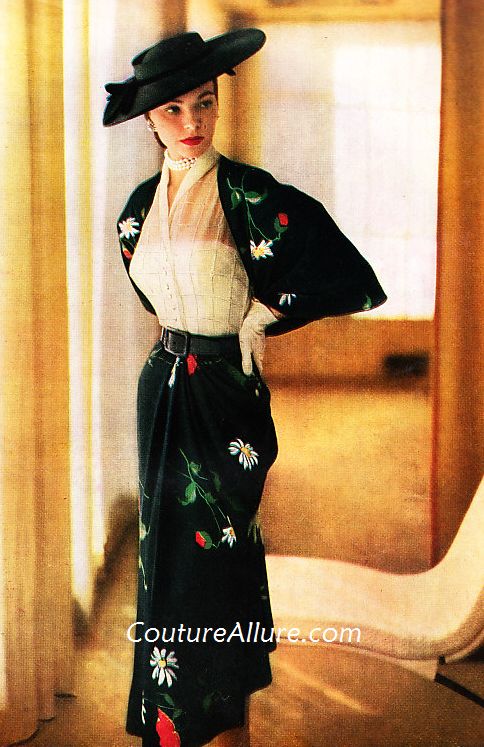
Could you just die? This stunning ensemble was designed by Omar Kiam for Ben Reig in the spring of 1949. The floral fabric is an Onondaga silk styled by Philip A. Vogelman. The little capelet jacket slips on over a sheer white blouse with pearl buttons. The pearls are echoed in a triple strand choker at the neck. Can you see the ingenious draping of the skirt? Click on the picture for a larger view if you like.But what about that chair she's standing in front of? Can anyone tell me about it?
Tailored Bias Cuts
Monday, June 22, 2009 Posted by admin at 3:51 AM 0 comments
When I say "bias cut", what probably comes to mind is sultry, clinging evening gowns from the 1930's or the 1990's. But a bias cut can be used to great effect in tailored garments as well.
What is bias cut? The straight grain of a fabric, either vertical or horizontal, has no stretch, unless it is a knit or is woven with a stretch fiber such as spandex or lycra. But when you turn the pattern 45 degrees, you are cutting on the bias, which has a gentle give and allows a softer and more fluid result. Using fabric cut on the bias is challenging, as it can stretch out of shape during the sewing process, so it requires more time and care to avoid distortion of the garment.
Here are a couple of examples of tailored garments with a bias cut from 1963, both made of linen. Notice how cutting the stiff linen on the bias gives these garments more softness, shaping, and fluidity. At the same time, the weight of the fabric allows the garment to float away from the body without clinging, a plus during the heat of summer.
An overblouse dress by Norman Norell in magenta linen. The front of the overblouse is cut on the bias so it floats softly over the underdress, but contours lightly to the body. A leather sash slips through slits in the front princess seams and is tied at the waist for more definition.
This shift dress by Ben Reig is fashioned from brown linen. A front zipper is hidden behind the decorative placket. Notice how the dress floats next to the body while the bias cut of the linen allows subtle shaping.
Just added at Couture Allure, this early 60's overblouse dress by Herbert Kasper in black rayon. The overblouse is cut on the bias for fluid shaping that softens the square cut.
What is bias cut? The straight grain of a fabric, either vertical or horizontal, has no stretch, unless it is a knit or is woven with a stretch fiber such as spandex or lycra. But when you turn the pattern 45 degrees, you are cutting on the bias, which has a gentle give and allows a softer and more fluid result. Using fabric cut on the bias is challenging, as it can stretch out of shape during the sewing process, so it requires more time and care to avoid distortion of the garment.
Here are a couple of examples of tailored garments with a bias cut from 1963, both made of linen. Notice how cutting the stiff linen on the bias gives these garments more softness, shaping, and fluidity. At the same time, the weight of the fabric allows the garment to float away from the body without clinging, a plus during the heat of summer.
An overblouse dress by Norman Norell in magenta linen. The front of the overblouse is cut on the bias so it floats softly over the underdress, but contours lightly to the body. A leather sash slips through slits in the front princess seams and is tied at the waist for more definition.
This shift dress by Ben Reig is fashioned from brown linen. A front zipper is hidden behind the decorative placket. Notice how the dress floats next to the body while the bias cut of the linen allows subtle shaping.
Just added at Couture Allure, this early 60's overblouse dress by Herbert Kasper in black rayon. The overblouse is cut on the bias for fluid shaping that softens the square cut.
Sparkle, Shimmer, & Shine - Beaded Fringe
Friday, November 7, 2008 Posted by admin at 3:51 AM 0 comments
Beads - they add that touch of sparkle to an evening gown that draws the eye and makes a woman feel special. Beaded fringe moves as you do, to create even more shimmer and shine. The above dress, by Ben Reig, was featured in the October 1963 issue of Vogue magazine. This dress would have been designed by Eva Rosencrans, whom we've discussed in the past. The bracelet is by Miram Haskell.
Beading dates back thousands of years, but glass seed beads, such as those used above, did not exist until about 1480, when Murano glassmakers in Venice invented a technique known as the hollow cane drawn method. Molten glass was gathered on the end of a tool called a puntile, a bubble was incorporated into the center of a gather of molten glass, and a second puntile was attached before stretching the gather with its internal bubble into a long cane. The pulling was a skilled process, and canes were reportedly drawn to lengths up to 200 feet long. The drawn tube was then chopped, producing individual drawn beads from its slices. In this way, glassmakers were able to produce large quantities of beads in a shorter time. Get some shimmer of your own with this light blue sequined dress that has beaded tassels on the bodice. This dress also dates to the early 60's and the beading was all hand done in Hong Kong. Available at Couture Allure Vintage Fashion. Click the picture for more details!
1961 Eva Rosencrans for Ben Reig Evening Gown
Wednesday, August 27, 2008 Posted by admin at 4:08 AM 0 comments
Eva Rosencrans worked in partnership with her sister-in-law, Nettie Rosenstein in a wholesale business named Nettie Rosenstein starting in 1931. They worked by draping dresses directly on medium sized live models, which meant that their designs flattered average American women. Another unique aspect of the business was that each dress was sewn by one seamstress from start to finish, rather than by assembly line. They kept the line exclusive by only selling to one store per city.In 1961, Nettie made the decision to leave the clothing business in order to concentrate on accessories. At this time, Eva Rosencrans went to design for Ben Reig. She was known for her luxurious but simple designs. This evening gown was featured in the September 15, 1961 issue of Vogue magazine, and was probably from her first line for Ben Reig.
"Liquid black: silk evening dress from the Ben Reig collection, designed by Eva Rosencrans." The dress has a draped bodice with straps that come from the side seams below the bust, criss-cross at the upper edge of the bodice and then encircle the neck. The skirt is softly gathered onto the waist and a tulip slit shows the leg from the knee to the hem. Love those long black kid gloves and the full length mink draped casually over the chair. The model is not wearing a hat, but has long dramatic chandelier earrings.

Get the look with this 1950's black velvet cocktail dress with its halter strap that can be worn many ways. Available at our website. Click the picture to see the listing.
Subscribe to:
Posts (Atom)